13/08/2026
Fire Safety Training for Corporate Offices in Bangladesh: What We Learned Training 40 Officers at SAJIDA Foundation
Sharif Al Mahmud
When people in Bangladesh talk about fire safety, they usually think about garment factories. That is understandable. Our factory fires have made national news for years. But corporate offices carry real fire risk too. And most offices are far less prepared than a compliant factory.
On 25 June 2026, our team ran a day-long Fire Safety and Emergency Rescue Training Program for the officers of SAJIDA Foundation. Forty people attended. In this article we share what we covered, why office fire safety needs its own approach, and how your organisation can build the same protection.
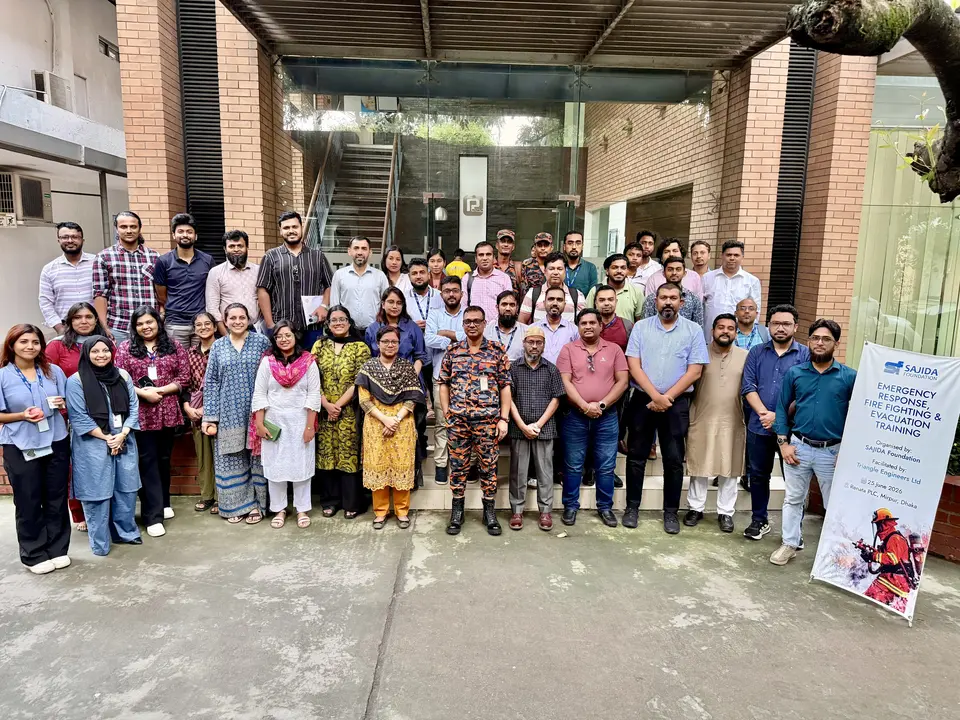
What happened at the SAJIDA Foundation training
The program ran for a full day at the SAJIDA Foundation Head Office. It was led by our Chief Consultant, Engr. Shahjahan Alam, together with Engr. Md. Parvez, Senior Engineer (Electrical Safety), and Engr. Sharif Al Mahmud, Project Coordinator and COO. We designed it for officers and staff, not for engineers, so the language stayed simple and practical.
The classroom sessions covered:
- Basic fire dynamics — how a fire actually starts, grows and spreads
- Case studies — real fire incidents and what went wrong in each one
- Common causes of fire in Bangladesh, with focus on office buildings
- Electrical hazards found on corporate office floors
- Safety techniques staff can apply every day
- Formation of a Fire Safety Management Team suited to their head office
The Fire Service and Civil Defence (FSCD) team then took over for the practical part. They demonstrated rescue techniques, post-rescue first aid, correct use of fire extinguishers, and other emergency response practices.
The day closed with refreshments, lunch and a group photo. We are grateful to SAJIDA Foundation for organising this kind of training to protect lives, property and business continuity.
Why office fire safety is different from factory fire safety
A factory has a compliance department, scheduled audits, and buyers who inspect the building. An office often has none of that. This creates a gap.
Here is what makes an office risky in a different way:
People are unfamiliar with the building. Factory workers stand at the same machine every day. Office staff move between floors, meeting rooms and departments. In smoke, that unfamiliarity costs time.
Escape routes get used as storage. Corridors and staircase landings slowly fill with old files, broken chairs, cartons and decoration items. This is one of the most common problems we find during office inspections.
Electrical load keeps growing. A floor designed years ago now runs many more computers, monitors, printers, routers, air conditioners and phone chargers.
Fire equipment is present but nobody is trained. Extinguishers hang on the wall, fully charged, with an expiry sticker. But if no one has ever pulled a pin under pressure, that equipment does not help.
Nobody has a defined role. During a real emergency, if no one has been given responsibility in advance, everyone waits for someone else to act.
Electrical hazards on office floors
Electrical faults are one of the biggest single causes of fire in Bangladeshi buildings. In offices, the pattern is very consistent. These are the problems we point out most often:
- Extension board chains. One multi-plug feeding another multi-plug, feeding a third. Each connection adds resistance and heat.
- Overloaded sockets. A single socket running a printer, a heater, a kettle and three chargers.
- Low-quality cables and plugs. Cheap accessories overheat at the contact point long before the breaker trips.
- Cables under carpets and behind furniture. The insulation gets crushed, and nobody sees the damage.
- Air conditioner circuits without proper protection. Split AC units are often added later, wired into whatever circuit is nearby.
- Server rooms and UPS rooms with poor ventilation. Heat builds up in a small closed room with no exhaust.
- Old distribution boards. Loose terminals, dust, and no thermal inspection for years.
- Appliances left running overnight. Water heaters, coffee machines and chargers left on after everyone goes home.
Most of these cost very little to fix. That is the good news. A simple floor-by-floor electrical survey will find nearly all of them.
How to form a Fire Safety Management Team
This was a major part of the SAJIDA Foundation session, and it is the step most organisations skip.
A Fire Safety Management Team is a group of named staff members with defined emergency duties. It is not an extra department. It is your existing staff, trained and organised in advance.
A workable structure for a corporate head office looks like this:
Team Leader / Chief Fire Warden. One senior person who takes overall command during an emergency and decides when to evacuate.
Floor Wardens. One or two people per floor. They sound the alarm, direct people to the correct staircase, and sweep the floor to check nobody is left behind.
Fire Fighting Team. A small group trained to use extinguishers and hose reels on a small fire only, in the early stage, and only if it is safe.
Evacuation and Search Team. They help guide staff, and pay special attention to anyone who needs assistance — pregnant colleagues, elderly visitors, and anyone with a disability or injury.
First Aid Team. Trained staff with an accessible first aid box, ready to give basic care until professional help arrives.
Communication Team. One person calls FSCD on 999 and gives the exact address and building details. Another manages information to management and to families, so rumours do not spread.
Assembly Point Coordinator. They hold the staff list, take the head count, and report who is missing.
Two rules make the team actually work. First, write the names on a notice board where everyone can see them. Second, name a backup for every role, because people take leave and travel.
Practical drills: why the FSCD demonstration mattered
Classroom knowledge is not enough. Under stress, people do what they have practised, not what they have read.
That is why we invited the Fire Service and Civil Defence team to demonstrate. Their session covered rescue techniques, first aid after rescue, and the correct procedure for applying a fire extinguisher.
Handling a real extinguisher for the first time teaches things a slide cannot. How heavy it is. How short the discharge lasts. How close you have to stand. How you must aim at the base of the fire, not at the flames.
What the law requires in Bangladesh
Many organisations do not realise that fire drills are a legal duty, not a good practice.
Under the Bangladesh Labour Rules 2015,
a mock firefighting and emergency exit drill must be organised every six months in line with Section 62(8) of the Bangladesh Labour Act, the record must be kept in Form-22(A), and the concerned Inspector must be notified in writing at least 15 days before the drill is held.
Three points are worth noting there, because organisations commonly miss them:
- The interval is every six months, not once a year.
- The written record in Form-22(A) matters as much as the drill itself. If it is not recorded, it did not happen.
- The advance written notice to the Inspector must go out at least 15 days before.
Alongside this, the Bangladesh National Building Code (BNBC) 2020 and FSCD requirements govern the physical fire safety systems in your building — detection, alarm, extinguishers, hydrants, exits and signage.
A simple starting checklist for your office
If you are responsible for a corporate office in Dhaka and are not sure where you stand, start here:
- [ ] Walk every escape route today and clear anything stored in it
- [ ] Check that every exit door opens in the direction of escape, and is never locked during working hours
- [ ] Confirm your extinguishers are the right type, in date, and mounted where people can reach them
- [ ] Test that the fire alarm can actually be heard on every floor, including toilets and server rooms
- [ ] Count how many staff have physically used an extinguisher — not how many have watched a video
- [ ] Name your Fire Safety Management Team and post the list publicly
- [ ] Check when your last drill was held, and whether it was recorded in Form-22(A)
- [ ] Get a qualified engineer to inspect your electrical distribution boards and AC circuits
If more than three of these give you an uncomfortable answer, your office needs a proper fire safety assessment.
Talk to us about fire safety training and inspection
Triangle Engineers Ltd. delivers fire safety training, inspection and audit services for offices, factories, hospitals and commercial buildings across Bangladesh. Our programs are led by our Chief Consultant, Engr. Shahjahan Alam — a BUET-graduate mechanical engineer with more than 25 years of experience in fire safety systems, including work on the Dhaka Metro Rail project and international assignments under World Bank funded projects — supported by a team of experienced fire safety engineers.
We can design a training program around your building, your staff and your actual risks — not a generic slide deck.
Email: [email protected] Phone: +8801325074113, +8801882651651 Address: House 02, Road 12/A, Sector-10, Uttara, Dhaka-1230